
The Reality of Automated Pool Cleaners: What They Can and Cannot Do
Robotic pool cleaners are advertised as magical devices. Simply put it in the pool, let it do its job, and return to a clean and sparkling pool. While the reality is not too far off from this sales pitch, as they do take care of a substantial amount of cleaning work, they are not a solution for the aspects of pool maintenance that are directly related to the health and safety of swimmers.
Three types of automated cleaners, three different trade-offs
Automated cleaners are not all the same, and the differences are more meaningful than most people assume going in.
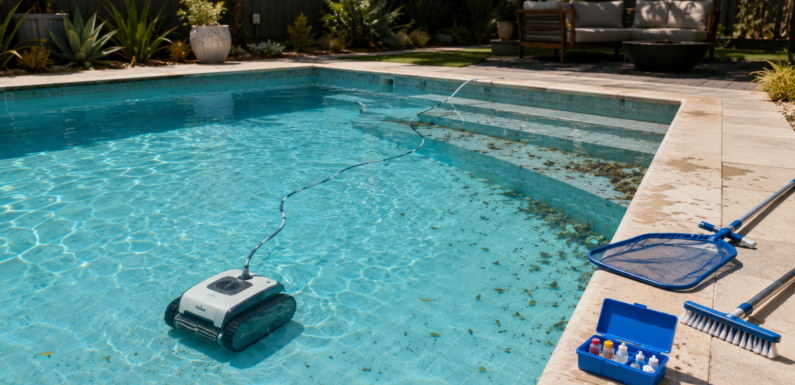
Robotic cleaners are self-contained units with their own motor and battery or power cord. They don’t rely on the pool’s circulation system, so they can map out the pool, scale walls, and often head under the waterline to scrub the tile. This makes them the most effective and the easiest to maintain because all the gunk they pick up isn’t going straight into your skimmer or filter. It also makes them the most expensive to purchase. They’re often priced somewhere between $800 to $2,500 AUD, and they’re an appliance in their own right, with their own brushes and tracks that wear down. Repairs after three to five years of use are routine.
Suction-side cleaners are the cheapest to buy. They simply plug into your skimmer line and operate based on the power of your existing pump’s suction. That makes them affordable upfront, but every bit of debris they pick up goes right into your pump basket and filter. That might mean backwashing or disassembling and hosing off the pool’s cartridge a lot more often, which is a hassle. They also don’t clean well as they move up the walls and over steps because the suction isn’t as good.
Pressure-side cleaners plug into the return line, which often requires its own dedicated booster pump. They are the multi-tools of the cleaner world. They use the most electricity and require the most pump power, but they’re great at picking up a lot of bigger debris and going over steps and benches. They deposit debris into a bag in the unit itself, which is easier on your filter and pool pump than the suction-side cleaner that’s capturing everything flowing through your skimmer. However, the booster pump is another piece of equipment that can go wrong.
What these machines actually do well
Acknowledge the benefits. A good robotic cleaner removes leaves, sand, grit, and fine silt from the floor and walls on a daily or other regular schedule, meaning it’s in operation more often than not because your kid is fetching it out to amaze a playdate. For most users, this eliminates about 50% of the total manual brushing and skimming to be done. That is not insignificant.
For the majority of users, the pool is virtually the same as a conventional pool. The whole point is that nobody has to notice or interact with the robot unless they want to. It just cleans the pool. You wouldn’t know I had one unless I told you, and I generally don’t.
The part nobody puts in the ad copy
Let’s bust this myth: a sparkling clean pool is not automatically a safe pool.
No robot – autonomous, suction, or pressure-side – makes the slightest difference to the actual state of the water. You still have to test things like pH, chlorine, total alkalinity, and cyanuric acid manually, using strips or a liquid kit, usually a couple of times a week. A robot also isn’t peering inside your pump basket to see if your flow rates are about to tank, or checking the filter pressure to determine if its cleaning ability has dropped off a cliff. A robot doesn’t know or care about any of that. It just scrubs a floor that was clean to begin with. If testing water and checking your pump and filter settings isn’t your idea of weekend fun, a pool cleaning perth service can keep that baseline healthy for you without it becoming another chore competing for your Saturday.
There are also places a machine can’t spit shine. Waterline tile – the strip where sunscreen, body oil, and makeup build into a grimy scum line – is mostly out of reach for floor-and-lower-wall-traveling robots. Calcium scale is even worse: once it forms, no brush-on-cleaner bristle is tough enough to remove it. That’s an acid wash or professional treatment situation, full stop. The other spots where gunk can hide are step corners, ladders, and light fixtures. Algae is particularly insistent in its favorite hidey-holes, and while a robot can suck up some of the loose stuff once it starts floating free, it can’t always keep a bloom from taking root. That requires a good old-fashioned brush and, often, a shock.
The maintenance the cleaner itself demands
Owning a robotic pool cleaner is like owning an additional vehicle. It requires maintenance and repairs, and neglecting these responsibilities will shorten its lifespan considerably.
All models have disposable and/or reusable collection bags or canisters, and they need to be emptied after every cleaning run. In windy conditions or during heavy leaf drop, you may need to empty them more often. You’ll also need to rinse out the filters that trap finer debris in most models. Hair, twigs, and other small bits of debris are also the leading causes of clogs in the impeller motors of most robotic cleaners. In addition, you’ll need to replace or clean the scrubbing brushes hidden beneath the machine, and the seals and hoses in the motors of suction-side and pressure-side models will eventually fail and need to be replaced.
All of these are relatively ordinary experiences for owners of pool robots. Just be sure to add the cost of replacement parts to your annual budget, right next to what you expect to pay to keep your pumps in good working order.
When the robot gets overwhelmed
Every robot cleaner has a limit, and there are many occurrences that simply exceed it.
Intense rain washes more dirt and debris into the pool than any single robot can handle. A night of heavy leaf fall can overwhelm a robot cleaner. A sudden algae breakout (either green or the more insidious mustard kind) can outpace a robot cleaner’s abilities. And if you’ve just had a pool party, with suntan lotion and spilled food creating general havoc, a robot’s nightly run just won’t be enough.
In any of these instances, it’s a manual pool sweep or a call to the pool guy that will ultimately solve the problem. But too often, the robot is seen as the sum total of the cleaning system rather than something that works in conjunction with it. Owners usually discover this oversight right before they want to jump in.
Why “swim-ready” is the real goal, not “automated”
Here’s the thing. If you see a pool robot being pitched as a “set and forget” substitute for pool maintenance, that overselling reveals the product wasn’t designed with your best interests in mind. Pool rats and marketers alike know that what you want isn’t a pool robot that “saves you time”, plays on your phone, or pairs with your smart home. You want a pool where the water is safe and clean and the surfaces are pristine because you’re raising your family around it. You want a lifestyle with a robot in it, not a robot and the weekly sigh of “pool cleaning” that still goes with it. A swim-ready pool is the destination, and it’s worth remembering that a robot is just one potential vehicle.
A weekly rhythm that actually works
Eliminate the “set and forget” mindset. Instead, program your robot to clean the pool at the same hour every day (most come with a timer you can preset). Run it for anywhere from 2 to 8 hours, or just long enough to make one pass over the entire pool, depending on the size of your pool and the strength of your robot.
Then, every weekend, spend 10-15 minutes skimming the surface with a net and brushing the walls and waterline with a nylon brush. Do the same for the steps (this is where that robot really falls down on the job) and give the corners some extra elbow grease with the brush. Repeat.
Twice per week, test the water for proper pH and chlorine levels. In hot weather, or after a weekend of heavy use, test again, or if in doubt test again. Sparkling, balanced water takes the romance out of pool ownership, but it sure is nice to swim in, right?
Finally, have your pool company come service your pool at least every three months to check the calcium levels of the water and tiles, and wash the filter. If tiles (not fiberglass) need heavier cleaning with acid or tile soap, have the pool maintenance folks do that too (unless you read up on doing it yourself).
The honest economics
An automatic pool cleaner is an expense but not a way to reduce pool maintenance to zero. In the range of $800-$2,500 AUD upfront, you’ll also have some parts and repairs needed through years three to five, so it’s an add rather than a subtract for your home budget. If you use a pressure-side cleaner that requires its own booster pump, you’re paying even more for the convenience of an unattended cleaner. What you’re not doing is spending 15-30 minutes each day (or more, if you skip a day) manually cleaning the pool. For some people, this trade-off isn’t worth it, which is why there are still basic pole-and-hose models for sale.
